

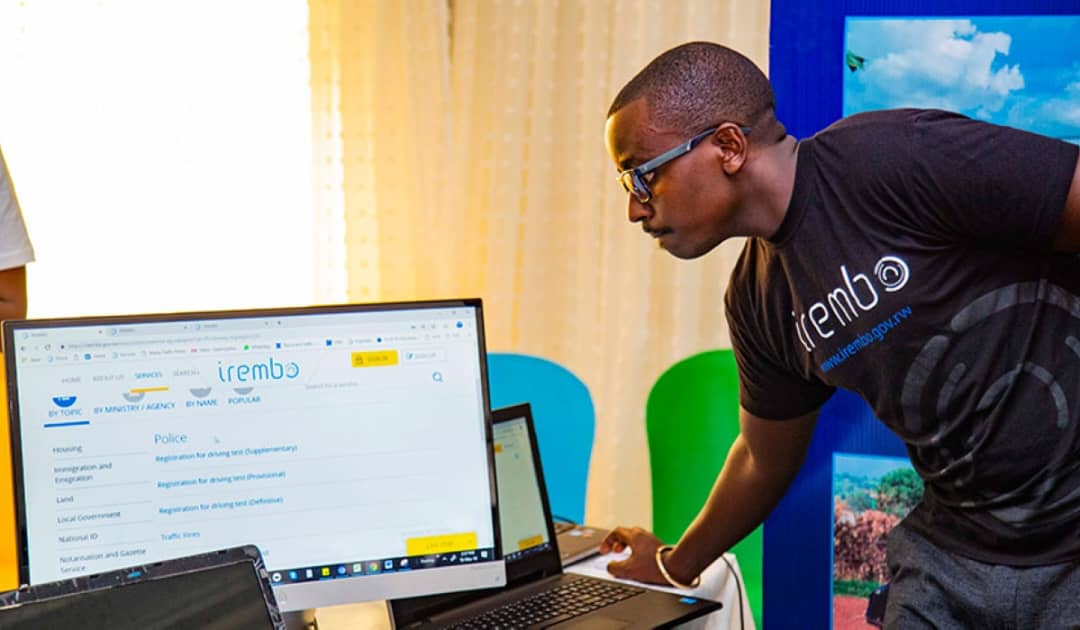
Rwanda has vowed to ensure 100% delivery of online government services, up from 40% in 2017, by 2024. The country remains a continental leader in digital governance, deploying modern systems like IremboGov, e-procurement, e-tax, e-recruitment, and the Integrated Electronic Case Management System (IECMS). Yet behind this ambition lies a growing digital divide that heavily affects rural women, people with disabilities, and low-income citizens.
Nearly 50 kilometres Southwest of Rwanda’s capital Kigali, in Rugendabari Sector of Muhanga District, pensioner Mukamurenzi Esperance survives on the monthly social security benefits that come from the government. However, changes in the management of the pensions sector, as the government switches to digital platforms ostensibly to improve efficiency, are making it difficult for elderly people like Mukamurenzi to maintain the records the state needs to continue sending their welfare funding.
“I often need the certificate of being alive every year because RSSB Rwanda Social Security Board requires it. And every month when I collect my pension, I come to the Irembo agent because I don’t know how to push and pull from my bank account to Mobile Money. I cannot do it myself because I don’t know how. Other rural women also struggle because many of us don’t have smartphones,” she said.
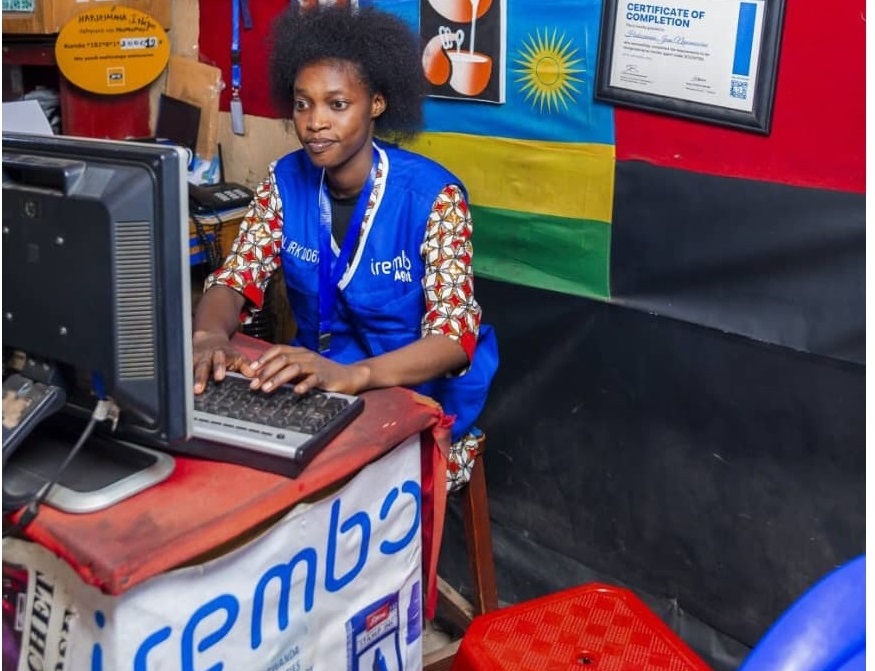
In 2015, the government of Rwanda partnered with a private entity to launch Irembo as a government services portal to help citizens and visitors apply for public services such as national identity cards, driving permits, marriage and birth certificates, land titles, immigration, health insurance, and pension, among others. Irembo agents are dotted across the country, helping citizens access public services through digital platforms, thereby easing the burden on those who are not tech-savvy.
According to Irembo agent Tuyisenge Thimothe, who has 11 years of experience at a local service point, a considerable number of Rwandan citizens — especially the most vulnerable in society — still depend on agents to complete applications because they do not have the technology to undertake the tasks on their own.
“There are services you can’t do yourself, and others that require an Irembo agent — that’s how the system works. The first challenge here is lack of smartphones. Rural women and people with disabilities often don’t have smartphones, and even when they do, internet access is limited,” he said.
A study conducted by the National Institute of Statistics of Rwanda (NISR) for the third quarter of 2024 reveals that 84.9% of households in Rwanda own a mobile phone, with 36.2% owning smartphones.
Overall the National Institute of Statistics (NISR) data show that 88.5% of men own a phone, with 39.7% of them owning smartphones, while 75.9% of women own a phone, with 27.1% owning smartphones.
According to Tuyisenge, poverty remains the biggest barrier to access to services through digital platforms, with printed documents and service fees creating further challenges for low-income families.
The digital barrier is not only affecting access to administrative documents. In Muhanga District, Uwizeyimana Germaine struggled to follow her court case through the Integrated Electronic Case Management System (IECMS), which has been operational since January 2016. IECMS is a unifying platform that connects all institutions belonging to the country’s justice, reconciliation, law and order sector.
“I was not familiar with digital tools, so I always needed to consult my lawyer just to access information about my own case. It cost me transport, accommodation for the lawyer, and delayed how fast I could get the court decision because I had to wait for him to check everything for me,” she said.
A study by Jean Leon Nduwimana on the effectiveness of the Integrated Electronic Case Management System (IECMS) found that usage and satisfaction remain low among rural users. Research conducted in Nyaruguru District showed that only 38.6 percent of respondents said they or someone they knew had ever used IECMS. Just 11.1 percent described the system as “very useful,” while 8.5 percent said it was “useful,” pointing to limited acceptance among users.
The study also found significant challenges related to usability and navigation. About one-third (33.3 percent) of IremboGov agents surveyed said the system was only “somewhat easy” to use. Users and trainees cited technical difficulties, poor user-friendliness, and challenges linked to low digital literacy and limited skills, highlighting how the digital divide continues to affect access to justice through online systems.
Even as challenges persist, some digital platforms have delivered positive results. In Kirehe District, e-procurement has increased women’s participation in public tenders, says Niyonzima Jean de Dieu, the district’s Procurement Officer.
“E-procurement has helped many women in our district to bid because the process is transparent and easy to follow. That is why many women participate, and many of them even win tenders more than men,” he explains.
At the national level, the Rwanda Governance Board (RGB) acknowledges gaps in digital equality. The most recent Governance Scorecard shows that while service delivery satisfaction is improving, levels remain lower among people with disabilities.
In 2024, the CEO of RGB, Dr. Usta Kaitesi, the scorecard shows that Rwanda still has a long journey ahead before the adoption and use of digital services becomes seamless, especially among the country’s vulnerable citizens.
“There is still work to be done for people with disabilities to enjoy full benefits of the laws, policies, and ministerial orders designed to facilitate their access to services. There should be urgency in addressing challenges that hinder good service delivery to PWDs,” she said.
Disability rights groups say several major platforms remain inaccessible. Emile Vuningabo, the Program Coordinator at the National Union of Disability Organizations of Rwanda (NUDOR), highlighted some of the challenges that blind citizens face in accessing e-government services.
“We are working closely with Irembo to make their services fully inclusive for blind citizens. As it is now, a blind person cannot complete most processes independently. They must be assisted by an agent, and that assistance costs money — a cost that a person without a disability does not face,” he said.
Vuningabo added that NUDOR has raised similar concerns with the Ministry of Labour regarding the e-recruitment system and other institutions running platforms such as e-bidding.
“A blind person should be able to apply for jobs or tenders on their own. At the outset, accessibility was not taken into consideration,” he noted.
Those concerns are echoed by blind citizens themselves. Kanimba Donathile, a blind woman, said Rwanda’s digital transformation has often stripped people like her of independence rather than strengthened it.
“There are still many challenges, especially because these systems are new and many people cannot use them independently,” she said. “Phones that are accessible for blind people are extremely expensive. Devices like iPhones or BlindShell phones cost a lot, and learning how to use them requires time and training. Even screen reader software is difficult to use, especially in Kinyarwanda.
“In reality, using a phone that reads what is on the screen in Kinyarwanda is very hard. The system often has to pass through other languages before it works properly. That is why many blind people are forced to depend on others just to access services that are supposed to empower us.”
Ikuzwe Callixte, 34, said the current design of e-government platforms makes them difficult to use for people with disabilities. “As things stand now, these systems are not easy for us. Because of how they are designed, we are forced to go elsewhere to get help, and another challenge is the lack of digital skills,” he said. “We are asking that these platforms be designed in ways that accommodate us, using what is known as assistive technology, so that we too can feel included like everyone else.”
Human rights defenders argue the problem is rooted in design. Sylvie Nsanga, a gender and human rights advocate, noted: “E-government services are not inclusive, especially for people with disabilities like blind and deaf citizens. If a person cannot see the screen or hear instructions, the system already leaves them behind. Inclusion must be built into the design, not added later.”
Government officials acknowledge that inclusivity remains a challenge. Richard Kubana, Director General in charge of community mobilisation at the Ministry of Local Government (MINALOC), which is mandated to address issues affecting women and vulnerable groups, said e-government services are not yet fully inclusive for all citizens, particularly people with disabilities and rural populations with limited digital skills.
“E-government services have not yet become inclusive for everyone, especially people with disabilities such as blind citizens, and for rural communities that lack digital knowledge,” he said. “However, this is a process. These systems are still new, and we are gradually working to ensure that no one is left behind.”
The Ministry of Gender and Family Promotion (MIGEPROF), did not respond to repeated requests for via calls, messages, and email.
However, despite these challenges, the government continues to expand projects aimed at closing the digital gap. On October 2, 2025, the Rwanda Information Society Authority (RISA) launched new Service Access Points in the Eastern Province, supported by the Ministry of ICT and Innovation (MINICT) and Ministry of Local Government (MINALOC), to bring digital tools closer to citizens.
The Muhura Service Access Points (SAP), is intended to provide internet access, laptops, smart boards, and trained support staff to help residents access digital services. According to government officials, SAPs aim to enhance digital literacy and support youth, women, and entrepreneurs by reducing the need to travel long distances for online services.
Many have labeled Rwanda’s digital evolution as one of the most ambitious in Africa. Yet, for all the steps Rwanda is taking toward a fully digital state, the lived realities of rural women, blind and deaf citizens, and low-income families reveal a persistent inequity that many say must be addressed. Digital transformation, if it is to fulfill its promise, must grow hand in hand with accessibility, affordability, and inclusion for all.
Mukanyandwi Marie Louise

Leave feedback about this