
The seventh Rwanda Demographic and Health Survey (DHS7), conducted by the National Institute of Statistics of Rwanda (NISR), shows that the number of mothers giving birth through Caesarean section continues to increase. It rose from 3% in 2005 to 24% in 2025. This means that nearly one in every four women gives birth through surgery.
This increase raises questions about whether Caesarean sections are only being performed when medically necessary or whether some mothers are choosing them even when normal delivery is possible.
Doctors explain that a Caesarean section is a medical procedure that can save the lives of both the mother and the baby when necessary. However, they warn mothers against treating it as an easier way to give birth because it can have effects on a woman’s health and on future pregnancies.
Caesarean Births Continue to Increase
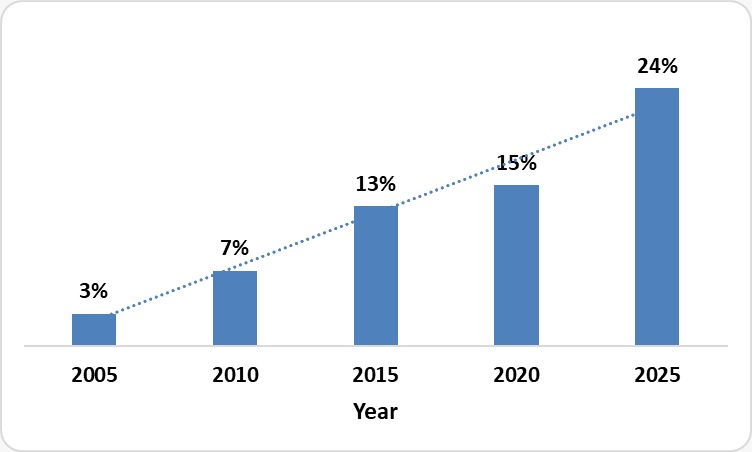
NISR figures show that in 2005, when the third Demographic and Health Survey (DHS3) was conducted, 3% of mothers gave birth through Caesarean section.
In 2010, during DHS4, this number had increased to 9%. In DHS5, conducted in 2014/2015, it reached 14%, while in DHS6, conducted in 2019/2020, it increased to 17%.
In 2025, DHS7 showed that the number of mothers who gave birth through Caesarean section had reached 24%.
This means that in five years, between 2020 and 2025, the rate of Caesarean births increased by 7 percentage points.
Graphic: The way caesarean births increased

Source: NISR
This increase may be linked to improvements in healthcare, especially the ability to identify problems that could put the lives of mothers and babies at risk and provide medical help in time.
Caesarean Sections Can Save the Lives of Mothers and Babies
The Director of Ruhengeri Hospital, Dr. Muhire Philibert, says there are different reasons why a mother may need a Caesarean section. These include a baby being too large, the mother’s pelvis being too small for the baby to pass through the birth canal, or signs that the baby’s life is in danger.
He says:
“Sometimes the baby is too big to be delivered normally, or the baby may have breathing problems. Some mothers have small pelvises, making normal delivery difficult. Others arrive at the hospital late with problems such as heavy bleeding. All these situations may require doctors to decide to perform a Caesarean section.”
Some Mothers Request Caesarean Sections
Some mothers who spoke to Ubumwe.com say they gave birth through Caesarean sections because of medical reasons, while others say they requested the procedure because they feared the pain of labour.
Ineza Karenzi Ange says she had already decided to give birth through a Caesarean section while she was still pregnant because she was afraid of labour pains.
She says:
“In my mind, I had already decided that I did not want anyone to see me suffering from pregnancy and labour pains. I also told my husband about it. When the time to give birth came, we went to the hospital together and asked the doctors to perform a Caesarean section. They agreed and asked us to sign some papers, which we did. Then they performed the operation.”
Iradukunda Uwase Angélique also says doctors decided to perform a Caesarean section after finding that her health measurements were not stable.
She says:
“When I arrived at the hospital to give birth, they checked me and found that my health readings were sometimes going down and then rising again. They realised this could cause problems for the baby and that the baby could even die in the womb. They decided to operate on me. The baby was born alive and healthy, and I also recovered well.”
The Risks Can Also Affect Future Pregnancies
The Director of Nyamata Hospital, Sebajuri Jean Marie Vianney, says a woman who has previously given birth through a Caesarean section may have a higher chance of needing another operation because of the scar left on the uterus.
He says:
“The scar on the uterus can cause it to tear or rupture. This can lead to the death of the baby or heavy bleeding in the mother, which could cause her death.”
Doctors explain that a scar on the uterus can also increase the risk of complications in future pregnancies. These include the uterus tearing or problems related to where the baby attaches inside the womb.
Uwera Didyne, who gave birth through a Caesarean section for the second time, says she has been experiencing back pain and pain in the lower part of her stomach for a long time.
She says:
“I always have back pain that does not go away. It makes it difficult for me to bend down or carry a baby for a long time. Even washing clothes is difficult. I have to put a basin on a chair and wash while standing. Sometimes I also feel pain in my lower stomach.”
Different Reasons May Be Causing the Increase in Caesarean Births
Dr. Anicet Nzabonimpa, an expert in reproductive health, especially women’s health and reproductive medicine, says the increase in Caesarean births may be caused by different factors. He believes that mothers and healthcare providers need to work together to ensure that Caesarean sections are only performed when necessary.
He says:
“Some women come to hospitals and request Caesarean sections. They even choose the date on which they want the operation to be performed. Others mix modern medicine with traditional treatment. They use traditional medicines and clay, which can have harmful effects on the baby. There are also women who do not attend all their scheduled pregnancy check-ups. In addition, there is a shortage of specialists who care for pregnant women.”

He adds that to reduce problems that may lead to Caesarean sections, pregnant women should start attending antenatal care services early and avoid taking medicines that have not been prescribed by doctors.
He says:
“What should be done is that every pregnant woman should start attending hospital services early and avoid traditional treatments and medicines that have not been prescribed by a doctor. Health centres and hospitals where women give birth should also have more healthcare workers so that mothers are attended to quickly when they arrive. This will help doctors respond quickly whenever medical help is needed.”
The World Health Organization (WHO) explains that a Caesarean section is a medical procedure that should only be used when there is a medical reason. Performing it when it is not necessary can cause problems such as heavy bleeding, infections, injuries to other organs inside the body and complications caused by anaesthesia.
In future pregnancies, a scar on the uterus can increase the risk of the uterus tearing or problems related to where the baby attaches inside the womb.
Dr. Bienfait NTSINZI, a specialist in women’s diseases and childbirth, says the increase in Caesarean births may be caused by different factors, including improvements in healthcare that make it possible to identify problems that could put the lives of mothers and babies at risk earlier.
He also says that changes in how mothers understand their rights to make decisions about the way they give birth may contribute to this increase.
He says:
“The increase in Caesarean births may be caused by many factors, including improvements in healthcare and the ability to identify problems early. Doctors are now better able to identify problems that could put the life of the mother or the baby at risk. There are also changes in how mothers understand their rights. In the past, we only performed Caesarean sections on women who had medical reasons. But now a mother can also request a Caesarean section and be allowed to have one.”
He adds that a woman who has given birth through a Caesarean section may not be allowed to try normal delivery in her next pregnancy. This depends on the condition of the scar on her uterus and other medical factors because attempting normal delivery may increase the risk of the uterus tearing during childbirth.
He also says:
“A Caesarean section should not be seen as an easier way to give birth than normal delivery. It is a medical operation that can have many negative effects. Therefore, it should only be performed when there are medical reasons, and it must be properly managed.”
RBC Figures Also Show an Increase in Caesarean Births
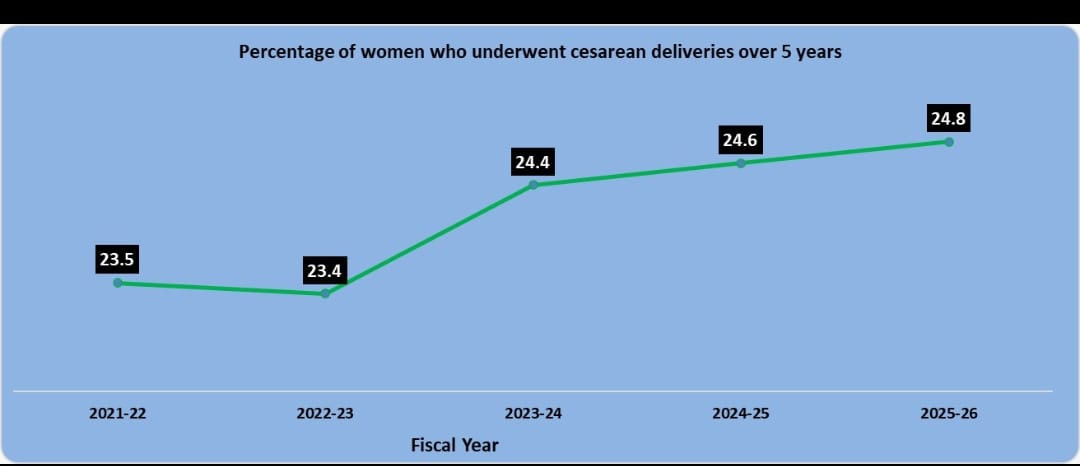
Figures from the Rwanda Biomedical Centre (RBC) show that the number of mothers giving birth through Caesarean section has continued to increase over the past five financial years.
In the 2021/2022 financial year, a total of 348,024 women gave birth. Among them, 81,680 had Caesarean sections, representing 23.5%.
In 2022/2023, a total of 348,549 women gave birth. Among them, 81,920 had Caesarean sections, representing 23.4%.
In 2023/2024, a total of 336,906 women gave birth. Among them, 82,351 had Caesarean sections, representing 24.4%.
In 2024/2025, a total of 343,821 women gave birth. Among them, 84,750 had Caesarean sections, representing 24.6%.
In 2025/2026, a total of 350,765 women gave birth. Among them, 87,120 had Caesarean sections, representing 24.8%.

Source: RBC
These figures show that although the total number of women giving birth changes from year to year, the number of women giving birth through Caesarean section continues to increase.
Maternal Deaths Remain a Public Health Concern
NISR shows that deaths among women caused by pregnancy- and childbirth-related complications have decreased. The number fell from 203 deaths per 100,000 live births in 2019/2020 to 149 in 2025.
The Government’s National Strategy for Transformation (NST2) aims to reduce this number to 60 deaths per 100,000 live births by 2028/2029.
This shows the importance of continuing to improve maternal healthcare services, helping mothers reach hospitals on time and giving them information that allows them to make decisions based on advice from medical experts.
Although Caesarean sections can save the lives of mothers and babies, they should not be treated as an easier way to give birth or performed without medical reasons.
The goal is not to reduce the number of Caesarean births at all costs. Instead, the aim is to ensure that every mother undergoes a Caesarean section when it is medically necessary, in order to protect her life and the life of her baby.
By Mukanyandwi Marie Louise